
The Refugee Data Portal includes data on all people affected by forced displacement and statelessness, to facilitate a complete understanding of the breath of the crisis. Populations are organized into four main categories and several sub-categories each with distinct definitions facilitating analysis, international cooperation and humanitarian action. They are present in the dimensional field population type (pop_type).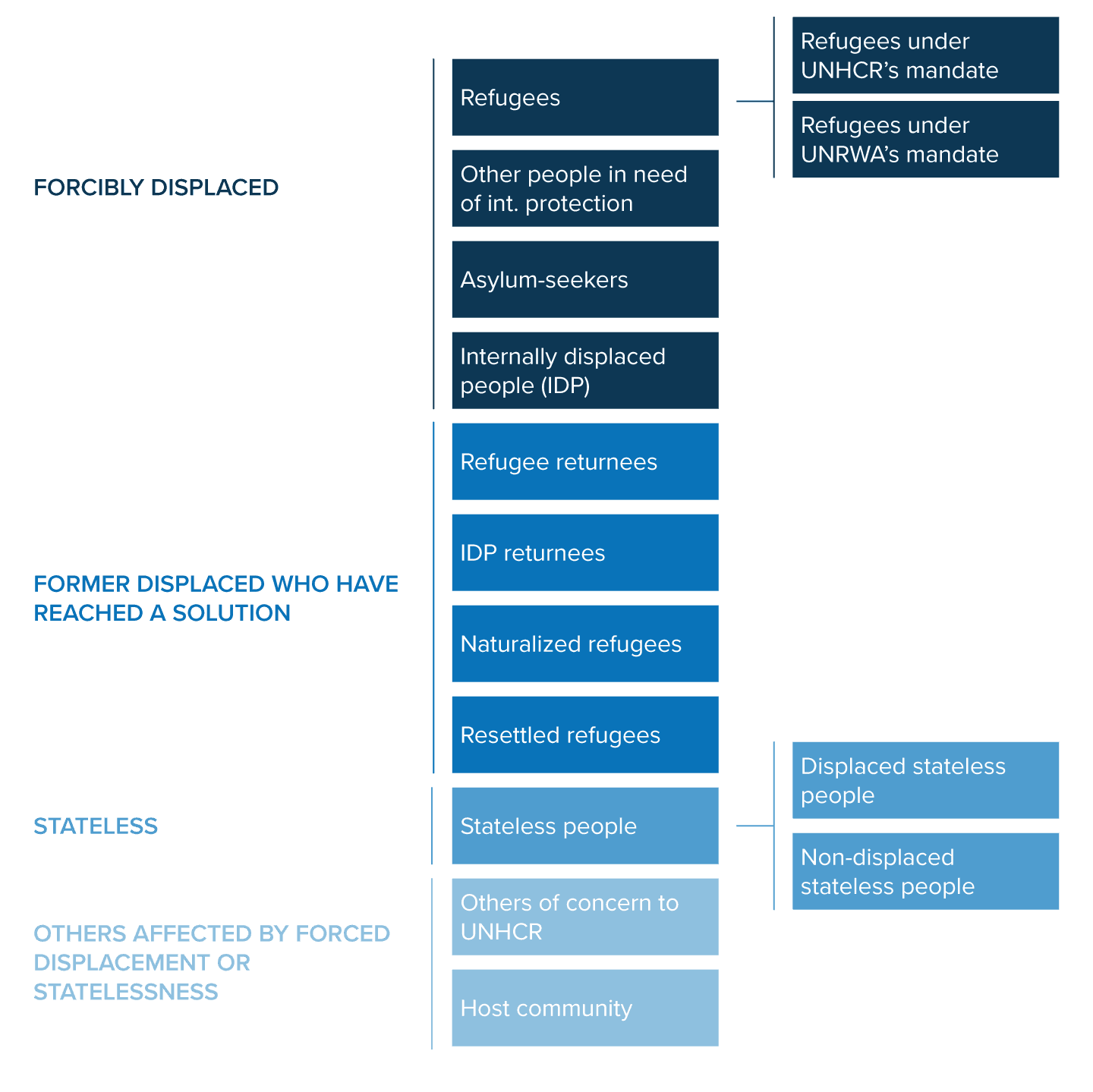
Note: The graphic above outlines the major population categories used for data compilation and analysis. Additional categorical groupings or sub-categories are also used in specific cases. They are explained further below under "other categories", together with their uses.
Forcibly displaced
Section titled “Forcibly displaced”Refugees
Section titled “Refugees”Any person who meets the eligibility criteria under an applicable refugee definition, as provided for in international or regional refugee instruments, under UNHCR’s mandate, or in national legislation.
Under international law and UNHCR’s mandate, refugees are persons outside their countries of origin who are in need of international protection because of feared persecution, or a serious threat to their life, physical integrity or freedom in their country of origin as a result of persecution, armed conflict, violence or serious public disorder.
Code: REF
Data use: This general category includes both refugees under UNHCR’s mandate and Palestine refugees under UNRWA’s mandate (see further associated definitions).
Note: Under international law, a person is considered a refugee as soon as they meet the relevant criteria, whether or not they have been formally recognized as a refugee. A person does not become a refugee because of recognition, but rather is recognized because they are a refugee.
Sometimes—notably in statistical contexts—the word refugee is used to designate individuals or groups who have been formally recognized by States or UNHCR as entitled to refugee status following an asylum or other status-determination procedure. When this limited nonlegal meaning is intended, it should be clearly indicated. The clearest designation in such contexts is recognized refugee.
Note: The 1951 Convention, at Article 1A(2), defines a refugee as any person who ‘…owing to a well-founded fear of being persecuted for reasons of race, religion, nationality, membership of particular social group or political opinion, is outside the country of [their] nationality and is unable or, owing to such fear, is unwilling to avail [themself] of the protection of that country; or who, not having a nationality and being outside the country of [their] former habitual residence … is unable or, owing to such fear, is unwilling to return to it.’ Notable regional refugee instruments include the 1969 OAU Convention and the 1984 Cartagena Declaration, which complement the 1951 Convention and build upon its definition, by reference to a number of ‘objective’ circumstances compelling refugees to flee their countries of origin, such as ‘external aggression, occupation, foreign domination or events seriously disturbing public order’ (1969 OAU Convention, art 1(2)) or ‘generalized violence, foreign aggression, internal conflicts, massive violations of human rights or other circumstances which have seriously disturbed public order’ (1984 Cartagena Declaration, para III(3)). UNHCR’s statute (1950) sets out the Office’s competence and international protection responsibilities towards refugees, by reference to a definition in very similar terms to that contained in the 1951 Convention (UNHCR Statute, art 6(A)(ii). The scope of UNHCR’s refugee-protection mandate has been clarified and broadened notably by subsequent UN General Assembly and Economic and Social Council (ECOSOC) resolutions.
See also: UNHCR glossary “refugee”
Refugees under UNHCR's mandate
Section titled “Refugees under UNHCR's mandate”This category is used when summarizing the total number of refugees that are under UNHCR's mandate, which excludes Palestinian refugees under the mandate of the United Nations Relief and Works Agency for Palestine Refugees in the Near East (UNRWA). Palestinian refugees residing in Jordan, Lebanon, Syria, the Gaza Strip and the West Bank (including East Jerusalem) fall under the mandate of UNRWA. Palestinians outside the areas where UNRWA operates who are unable to (re)avail themselves of UNRWA’s protection or assistance for objective reasons fall under UNHCR’s mandate.
Code: REF_UNHCR
Data use: This category is used for official population statistics, where refugees under UNHCR's mandate are clearly distinguished from those under UNRWA's mandate.
Palestine refugees under UNRWA's mandate
Section titled “Palestine refugees under UNRWA's mandate”Palestinian refugees residing in Jordan, Lebanon, Syria, the Gaza Strip and the West Bank (including East Jerusalem) fall under the mandate of the United Nations Relief and Works Agency for Palestine Refugees in the Near East (UNRWA). Palestinians outside the areas where UNRWA operates who are unable to (re)avail themselves of UNRWA’s protection or assistance for objective reasons fall under UNHCR’s mandate.
Code: REF_UNRWA
Data use: This category is used for official population statistics, where refugees under UNHCR's mandate are clearly distinguished from those under UNRWA's mandate.
Other people in need of international protection
Section titled “Other people in need of international protection”People who are outside their country or territory of origin, typically because they have been forcibly displaced across international borders, who have not been reported under other categories (asylum-seekers, refugees) but who likely need international protection, including protection against forced return, as well as access to basic services on a temporary or longer-term basis.
Code: OIP
Data use: Other people in need of international protection are included in the global forced displacement totals.
Note: Venezuelans previously designated as “Venezuelans displaced abroad” are included in this category. This change has been made retroactively in UNHCR’s statistics since 2018 and the term Venezuelans displaced abroad will no longer be used.
Asylum-seekers
Section titled “Asylum-seekers”A general term for any person who is seeking international protection. In some countries, it is used as a legal term referring to a person who has applied for refugee status or a complementary international protection status and has not yet received a final decision on their claim. It can also refer to a person who has not yet submitted an application but may intend to do so, or may be in need of international protection. Not every asylum-seeker will ultimately be recognized as a refugee, but every refugee is initially an asylum seeker. However, an asylum-seeker may not be sent back to their country of origin until their asylum claim has been examined in a fair procedure, and is entitled to certain minimum standards of treatment pending determination of their status.
Code: ASY
Data use: This category is used for official population statistics or other data and statistics where a distinction can be made between people seeking international protection pending their claim and those who have been granted refugee status.
See also: UNHCR glossary “asylum-seeker”
Internally Displaced People (IDP)
Section titled “Internally Displaced People (IDP)”A person who has been forced or obliged to flee from their home or place of habitual residence, in particular as a result of or in order to avoid the effects of armed conflicts, situations of generalized violence, violations of human rights or natural or human-made disasters, and who has not crossed an internationally recognized State border.
Code: IDP
Data use: This category is used for official population statistics or other data and statistics as a specific disaggregation.
See also: UNHCR glossary “internally displaced person (IDP)”
Former displaced who have reached a solution
Section titled “Former displaced who have reached a solution”People who were once refugees or IDPs who have reached a solution to their displacement, normally within a specified time period.
Code: SOL
Data use:This category is used as a way to bring together all categories related to solutions, regardless of the specific pathway through which the solution was achieved.
Refugee returnees
Section titled “Refugee returnees”A former refugee who has returned from a host country to their country of origin or former habitual residence, spontaneously or in an organized fashion, with the intention of remaining there permanently and who is yet to be fully integrated. Returnees include those returning as part of the operationalization of the cessation clauses in the 1951 Convention and regional equivalents.
Code: RET
Data use: This category is used for official population statistics or other data and statistics as a specific disaggregation.
See also: UNHCR glossary “returnee”
IDP returnees
Section titled “IDP returnees”Internally displaced people who return to their previous place of residence.
Code: RDP
Data use: This category is used for official population statistics or other data and statistics as a specific disaggregation.
Naturalized refugees
Section titled “Naturalized refugees”Refugees that have naturalized in their country of asylum. Naturalization is the legal act or process by which a non-citizen in a country may acquire citizenship or nationality of that country.
Code: NAT
Data use:This category is used to report refugees who have acquired citizenship of their host country and therefore achieved a legal solution through naturalization.
See also: UNHCR glossary “Naturalization”
Note: The International Recommendations on Refugee Statistics make several recommendations on appropriate indicators for measuring and quantifying local integration in a way that is comparable and consistent across different contexts. However, the availability of such data about refugees remains very poor. Even data on naturalization is limited by the uneven availability of data and poor coverage as well as policy and legal changes over time. In particular, it can be difficult to distinguish between the naturalization of refugees and non-refugees. Therefore, the data are only indicative at best and provide an underestimate of the extent to which refugees are naturalized.
Resettled refugees
Section titled “Resettled refugees”Refugees that have been identified and with their agreement, transferred from a State in which they have sought treaty protection to a third State that has agreed to admit them – as refugees – with a pathway to naturalization.
Code: RST
Data use:This category is used in resettlement statistics to monitor the movement of refugees from a country of asylum to a third country that has granted permanent residence or another long-term protection status.
See also: UNHCR glossary “Resettlement”
Note: Official statistics on resettled refugees are resettlement arrivals and are according to government statistics. They include those who arrived via sponsorship pathways.
Stateless
Section titled “Stateless”Stateless people
Section titled “Stateless people”A person who is not considered as a national by any State under the operation of its law, either because they never had a nationality, or because they lost it without acquiring a new one.
Code: STA
Data use:This category is used to report all people who are stateless regardless of whether they are also displaced or not displaced.
See also: UNHCR glossary “Stateless person”
Note: Not all stateless persons are refugees, but they may qualify as such if they are unable or unwilling to return to their place of habitual residence due to fear of persecution on one of the 1951 Refugee Convention grounds. That said, the protection of all stateless persons falls within UNHCR’s mandate.
Displaced stateless people
Section titled “Displaced stateless people”People who are both stateless and displaced. As such displaced stateless people are also reported in their respective forcibly displaced population category, i.e. as refugees, IDPs or asylum-seekers.
Code: STA_D
Data use:This category is used to disaggregate among stateless who are also forcibly displaced.
Non-displaced stateless people (STA_ND)
Section titled “Non-displaced stateless people (STA_ND)”People who are stateless but not displaced
Code: STA_ND
Data use: This category is used to disaggregate among stateless but are not forcibly displaced.
Others affected by forced displacement or statelessness
Section titled “Others affected by forced displacement or statelessness”Others of concern to UNHCR
Section titled “Others of concern to UNHCR”People who do not necessarily fall directly into any of the forced displacement and statelessness related classifications, but to whom UNHCR has extended its protection and/or assistance services, based on humanitarian or other special grounds.
Code: OOC
Data use: This category is used for official population statistics or other data and statistics as a specific disaggregation.
Host community
Section titled “Host community”A community that hosts large populations of refugees or internally displaced people whether in camps, integrated into households, or independently.
Code: HST
Data use:This category is used for contextualization and comparative analysis to understand how the characteristics, conditions or outcomes of forcibly displaced and stateless people compare with those of the communities hosting them. It is distinct from the general population, as host communities are specifically defined by their relationship to displaced populations.
See also: UNHCR glossary “Host community”
Other categories
Section titled “Other categories”General population
Section titled “General population”De facto population in a country, area or region without specification as to their displacement status.
Code: GEN
Data use: In the context of forced displacement and statelessness data, the general population serves as a reference group for contextualizing analysis and comparing outcomes between forcibly displaced and stateless people and the wider population. Unlike the host population, the general population is not defined by a relationship to displacement. Depending on the design of the data collection, the general population may include forcibly displaced people, host communities, returnees, stateless people, and other groups when these populations are not separately identified in the data.
Refugees and Asylum-seekers
Section titled “Refugees and Asylum-seekers”Includes both refugees and asylum-seekers (see associated definitions).
Code: RAS
Data use: This category is used mostly in surveys when a distinct disaggregation cannot be made between refugees and asylum-seekers due to the sampling design or statistical power.
Internally Displaced People (IDP) data compiled by IDMC
Section titled “Internally Displaced People (IDP) data compiled by IDMC”Internally Displaced People (IDP) data compiled by IDMC
Code: IDP_IDMC
Data use: This category is used to distinguish the official population statistics curated and published by the Internal Displacement Monitoring Centre (IDMC), which is what is used to compute the global totals of forcibly displaced.
Internally Displaced People (IDP) protected and/or assisted by UNHCR
Section titled “Internally Displaced People (IDP) protected and/or assisted by UNHCR”Internally Displaced People (IDP) protected and/or assisted by UNHCR.
Code: IDP_UNHCR
Data use: This category is used for UNHCR population statistics reporting to distinguish those IDP's it protects and/or assists with its programming.
Returnees
Section titled “Returnees”Includes both refugee returnees and IDP returnees (see associated definitions)
Code: RTN
Data use:This aggregate category is used when statistics combine both refugee returnees and IDP returnees, or when these groups cannot be distinguished separately in the source data.