
All statistical data published on the Refugee Data Portal in the data finder follows closely the Statistical Data and Metadata Exchange (SDMX) data modeling standard. This section presents how it is applied.
Core concepts
Section titled “Core concepts”The five principal concepts that guide data management are as follows:
- Data source (
data_source): A distinct survey, census, administrative source, statistical compilation exercise or other structured source of data from which observations originate. Every observation in the database is linked to at least one data source. - Dataset (
dataset): Organized collection of data defined by a common data structure. - Data series (
data_series): Set of observations disambiguated by the values of a single or combination of dimensions, namely time (time_period), location (ref_area) and population type (pop_type) but also other key dimensions when relevant such as country of origin (area_ori), nationality (nationality), age (age), etc. - Observation (
obs_value): Single record in a data series, normally represented by one row. Each observation has an observation value.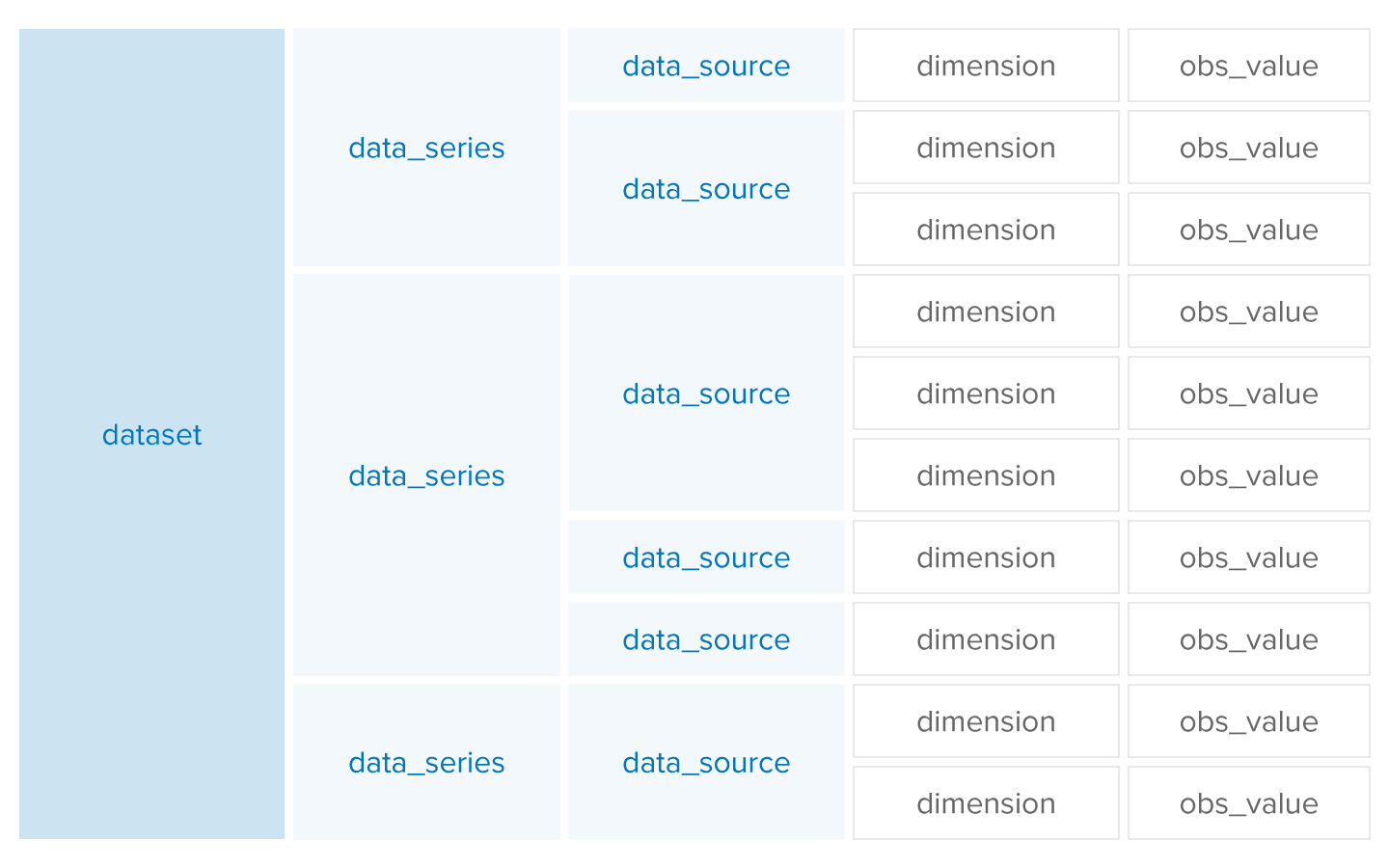
The following general concepts apply:
• Each dataset has a distinct data structure defined by a standard set of dimensions and attributes.
• Each dataset has at least one data series attached to it, and no data series can belong to more than one dataset.
• Each observation has one data source attached to it, while a dataset or data series can have one or more data sources.
• All dimensions are populated using standardized code lists (see below).
How observations are uniquely identified
Section titled “How observations are uniquely identified”Observations are uniquely identified through the combination of available dimensions. For example, the value (obs_value) for a given date, country, population type, sex and age group is identified by combining the following dimensions: time_period + ref_area_adm0 + pop_type + sex + age.
General universal logic
Section titled “General universal logic”_t _o _x _z